 Episode 2
· 29:02
Patrick Rife (00:14.018)
Hello and welcome to another edition of the Ground Control Podcast. I am Patrick Rife This is the Ground Control Podcast and this is episode number two. This week we're going to talk about a tool that I put out.
that we'll link to in the show notes. So if anyone is seeing this and you want to check it out, you can. It's called the Blind Spot Finder. But really, this week wasn't necessarily about shipping a tool so much, about everything that happened on the way to shipping a tool. So without further ado, the idea here was I started noticing a pattern as I was working with some of my clients.
clients for sure, but then also people that I was talking to that didn't end up turning into clients and just recognizing there was a theme in the gap that kept arriving as we were digging into what was going on with them. And what quickly became apparent was how hard it is for so many solopreneurs and executives and people that work alone inside of
bigger companies, but they're like ultimately on their own to get some perspective on what they're doing. That the blind spots were kind of rampant. And a lot of my early conversations were helping to kind of pull that all apart to really show what was happening. And it started the seed of an idea to like, how could we better surface these things where it didn't need to necessarily happen here? One, because a lot of people either aren't looking to work with somebody on a long term basis.
Or two, they just need it to be more concise. What they're looking for is a definitive feedback loop and not necessarily somebody to tell them what that is. So that's kind of what inspired the pursuit and the walk towards the blind spot finder. As I've mentioned a little bit earlier, if anyone's been following along, this is definitely version one of the blind spot finder. I've got some other things that I wanted to add to it and
Patrick Rife (02:27.456)
I was really sitting there kind of on the precipice of trying to determine, you know, like, do I wait and continue building out the whole vision for this thing or do I just ship it? And what I decided to do is just ship it. So there will be a V2 that comes along that will add some additional bells and whistles and insights. But for right now, like I figured, fuck it. Like it's time to get it out there and let people start using it and get some feedback in and we'll see how it goes. So.
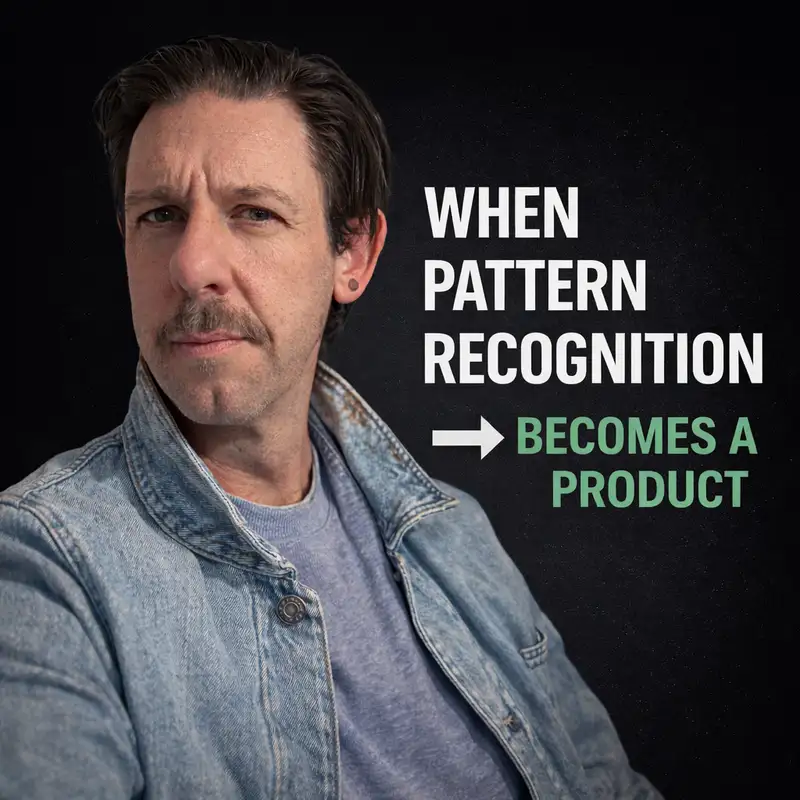
Today's episode is going to be about what happens when pattern recognition stops living just in your head and it becomes something tangible, right? So see something, do something might be the theme for this week's podcast. So at any rate, I kind of want to just get into a little bit of the patterns that I started to see. And then, you know,
how the idea came to be. then I also at the end, I'm to touch on something that's not the blind spot finder version three. And instead it's something else that I've wanted to build for a long time. And I hope that we'll be able to roll that out in future episodes, but ideally not too far in the future. jumping right in, right? So the patterns that I couldn't ignore after a while. So across sessions with.
Again, clients and non-clients, I kept encountering people who they were thoughtful, self-aware, doing the work, knew what the goal was, but still unable to move forward in any kind of meaningful way. In a way that checked the boxes of what they were trying to do and it qualified and it made sense. And the common thread that ran through all of these people, it wasn't
it really wasn't confusion and it certainly wasn't resistance because, know, generally speaking, by the time I started having a conversation with someone, the resistance isn't there. What they're looking for is a solution and permission to refute that resistance. More than anything, it was just a lack of orientation.
Patrick Rife (04:51.059)
really missing a starting point that made everything else clear, right? Everything felt heavier than it needed to be because from an alignment perspective, it was hard to know like exactly which of these things they should be putting forward. And I think that that's problem that we all have constantly. And that's why having a feedback loop is invaluable because it's very hard to see the forest for the trees, even if
your ideas are excellent and if executed properly, they will give you the returns you're looking for. It doesn't mean that you understand where to start. like, can add more frameworks, insights that didn't resolve that tension. In many cases, it made it worse, right? Because it's giving them more to hold on to without giving them direction. One of the things that I say a lot is with ground control, I...
I crafted it into these three buckets. Like one is coaching, one is consulting, and one is strategy. And I see them working together because a lot of times if you don't, if you've had a strategy that makes all the sense in the world, but it's not working, oftentimes there's a reason behind that. And usually that reason is the person that's trying to deploy it, right? So when I,
think about it when I talk about coaching and consulting and strategy, you know, like they're, they're not all jumbled together. And I think that, you know, going back to last, last week's episode, and if you haven't checked it out for context, I would encourage anyone to go back and check it out. It's episode number one. We're not that deep here. Um, still time to catch up on all your favorites. Um,
I think that the idea here is that if you don't have that clarity of what you're trying to do, if you don't know how to get out of your own way, it can be nearly impossible to figure things out. And a lot of times in this blend of coaching, consulting, strategy, if you've tried strategy before and it hasn't worked and you're the operator,
Patrick Rife (07:10.185)
Like there's a very good chance that the reason it hasn't worked is something internal, right? And you can write all the strategies on your own. You can write the strategies with partners, but if you don't believe in it or there's something that is blocking you from executing it in a way that's actually going to make it make sense, that's a problem. So a lot of times what I realize and I'm talking to people is figuring out, when we start to do the work, like,
Are we starting with the consulting side, which is really understanding the business, understanding the challenges and the goals, and then building a strategy to deploy against that? Or have there been smart, competent, potentially successful strategies in the past that have just not worked for some other reason? And if that's the case, there's no reason to write new strategies. There's no reason to consult about the business side of it right now.
because first we need to start back with the.
If we come up with a competent plan, how can we trust that you're going to believe in it to be able to deploy it successfully? And that's a hard thing to get over. At the end of the day, it's a hard thing to get over. in my experience, and I think it's fair to say that there are a million ways to tackle the bear. this is just my singular perspective. The whole thing about ground control is that this is me. This is how I wanted to approach things.
That being said, if you don't have conviction in yourself and what you're trying to accomplish and the willingness to go forward in doing it, you need to solve for that first. Once you solve for that, you can move past it. So in the work, what became clear is that the momentum side of it, it doesn't come from understanding more so much as it comes from knowing where to place your attention first. More strategies is never going to help.
Patrick Rife (09:12.271)
you execute the three strategies that you're already struggling to execute. It's only going to confuse things more. So the Blind Spot Finder is really, it's just a simple questionnaire and process to help you work through what is the task at hand? What are the best ways that success manifests itself? And then like, what's the shortest path between those two? And then once you have that,
it's much easier to start to map it out, right? Once you have that, then you can work with yourself, right? Work with someone else and say, yes, I know that this is what needs to happen and I know that I am bought in, right? I know definitively that more than all five of these things, this one thing is the thing that's gonna take me where I need to go. And it doesn't mean that all of those other things aren't valid, they're not gonna work, they're not gonna have really intentional.
impacts on your business, but just not yet. So the whole thing here is how can we drill down to make something intentionally simple so that way you can execute it? Because complexity is a way of hiding from the real work. Let me say that one more time for anyone that is listening or didn't hear it. Complexity is almost always a way of hiding from the real work.
If you are spending your time building too many lists and you're not spending your time executing the first four bullet points, you're getting in your own way. You're using overthink to make it seem more complicated. And maybe it's your ego that needs it. And that's okay, by the way. an ego is part of all of us. Ego drives me forward every day as well. It doesn't have to be a bad thing.
Too much of it is not necessarily a good thing. Everything is good and balanced. But it's important to know that if your ego is making your to-do list super long and your results are moving in the opposite direction, that's a big part of the problem. And it's OK to say that. It's OK to admit that what I have been doing is not what I'm going to be doing forever and that I need to make a change to be able to move forward.
Patrick Rife (11:31.144)
all those other strategies, like they can go on the Post-it Note for round two and round three and round four. But I promise, stripping it all the way back and getting to the essence of what you're trying to execute and putting your shoulder against that tackling dummy is really worth it because what you'll find is you start to see progress very quickly when you're only focused on one single thing, right? So again, Blind Spot Fighter.
Not a personality test, not a diagnostic tool, like none of that stuff. It's a way to surface what's actually in the way before we start trying to fix anything or everything else. It's fair for me to say here. So again, the vision for Ground Control Podcast is not prescriptive, right? It is not do this. It is, this is what I've done and this is what I'm learning, right? And I'm gonna continue to double down on that.
Because, to be completely fair, I launched Blind Spot Finder on Monday. Publicly, anyway. It's been on the web. There's a link to it on the website. It's been there for a couple weeks now. But I started talking about it on Monday. And that means that I have not run enough people through it yet to make strong claims about the outcomes. And being honest about that feels very, very important for me to say out loud.
Because what I'm doing is I'm trying things, right? Like not holding it back for V2 and letting it go at V1 is, it wasn't intentional, but my decision to do so is intentional. Because if I just sat on it for three more weeks while I waited for it to done, it would do a handful of things, right? It would keep me from publishing the things that I wanna publish, right? Like I have a whole strategy in place and part of what I need to do to get out of my own way.
is to follow that strategy that I've written, right? To not allow a chink in the armor to push it all back and then I have to refactor everything. And then all of sudden, all of the work that I did to lay the ground for what I want to do, it all gets pushed by a week. And then the dates skew. And then as soon as the dates skew, it opens up that little space in our minds to start questioning, did I do this right? Why did I do it this way? What should I have done wrong? What should I have done different?
Patrick Rife (13:50.244)
Like all of those things and slowly but surely those are the things that give us permission to be like, well, hold on, let me refactor the whole thing. Like this was not built from certainty. It was built from repeated exposure to the same constraint and a willingness to respond to it cleanly and clearly. Like that is the basis for ground control. That is the basis for blind spot finder. It's all about what can I learn right now?
What is a reasonable plan that I can deduce to test that hypothesis? And then how do I do it? Build, deploy, learn. That is my whole mantra. It will probably shift over the years. It will probably evolve as I settle more into what I want to do.
it'll get clearer. I will understand and I won't have to dawdle quite as much. But I hope that I will remember that when things start to feel ambiguous or unclear that I will remember to dawdle, that I will remember to take time to think more thoroughly about less things than to think less thoroughly about more things. So, surprising part of launching the tool and of having...
frankly, clients start to use it, is watching the reflections that felt so straightforward to me land as really profound for people on the other side of the conversation. For a while, I was a member of Greg Eisenberg's Community Empire, which is an awesome...
community that's hosted over on school. I'm not a member of it anymore, but just because I didn't really have the time to invest in it to get the return and there's some other imposter syndrome reasons why I needed to kind of pull out of it at that point in time. But when I was in it, was really, it was an amazing community to be able to connect with other builders that were trying to do things and...
Patrick Rife (16:06.179)
And I set up a lot of calls. I had a lot of one-on-ones with people because I love to, I love to hang. If you're watching this and you're like, man, Patrick seems like a cool dude. Like I'd love to have a one-on-one with him sometime. Like shoot me a DM. We can set up a 15 minute coffee or tea and just wrap.
Patrick Rife (16:29.72)
The thing that happened in all of those calls that I set up and quite frankly, happened two weeks ago with Justine. Justine, someone that Renee introduced me to. Thanks, Renee. Justine and I had like a 20 minute or 30 minute calendar thing set up to chat with one another about potentially working together, which was awesome. And I approached it exactly as that. But what happened inherently is,
getting into the conversation and it's just my way finding mechanism, the way that I find my way through a conversation with someone with getting to know them that it just, the onion blooms, right? And what happened in the conversation with Justine as an example, Justine, I hope you don't mind me putting you on blast. I don't share any gory details, but the long story short is we spent 90 minutes on the phone with one another.
and had an exceptional conversation. But what happened in it is something that happens frequently on calls. And it's not something that I know how to or do intentionally, but I listen to people and I say back to them what I think I have said. I feel like I say to them verbatim what they have said to me as they're explaining what it is that they're working on or like.
challenge that they're having, what they're trying to accomplish, and maybe like what the block looks like, and I just listen and then I say it back to them. And inherently, that recontextualization of their words, the things that they said as repeated once it's filtered through my brain, it reveals something and it resonates. And I think that, you know, like in doing this, the gap revealed something, it's uncomfortable oftentimes.
but it's clarifying. And all of a sudden, what feels obvious from inside often feels invisible from outside and vice versa. And when you start to go through and have these conversations, all of a sudden you start to get perspective on it, which is amazing. I'm learning that the value of my work, it's not in...
Patrick Rife (18:55.886)
complexity or cleverness, but in removing the noise until the signal is like very, very clear. One of the things that I really love is when a client or someone comes to me with something that feels very obtuse to them and they're hemmed up about it. And it's literally holding them back from making a singular decision. And for them, they're like, there are all these elements and I give them what I feel like is going to be
I don't know an underwhelming answer right I'm worried that it's going to be too frank or too forward or too too simple and It never is it always ends up being wait like that's like that's exactly it and their feeling isn't Well, you're phoning it in like that's not enough their feeling is that's exactly right, and I just couldn't see it
And I'm so glad that we could talk really quickly, right? I'm so glad that you were available to be able to help me like look around this corner and realize that it's not that big of a deal. oftentimes I'm saying like it's just not that big of a deal. you're overthinking it. I remember talking to a client that was really struggling with language on a page, language on a landing page for an event she was hosting and she was really worried.
that in targeting a specific group, because that's how we were niching down, right? This specific thing was for a specific subset of people in her world. She was very concerned that she would be turning other people off, that they would read it and they would be like, how dare she exclude me from this opportunity, right? That was a perspective.
of hers, right? It's that thing where we're like, I'm doing this thing and everybody's like silently standing around saying like, what a jerk, like, like how much of a like, can you believe Patrick has a podcast talking about this bullshit? And he thinks that anybody cares. Like, like I've got that internally, like that happens in my head as well. But I quiet it because I also know that there are people that do care and that are finding this interesting. So in that regard, like to it, I just like, it's just not that complicated. And one,
Patrick Rife (21:22.891)
people aren't thinking that of you. So for one, stop. Like stop letting you introduce a narrative about other people that is completely unproven for sure. There's no evidence of it, but most likely it's untrue. It's you and your self-consciousness that's allowing you to invent this narrative. But more so, what I said was rather than worrying about it like that, like let's put the comment there that says this is the deal.
and I'm like, let's, let's put an asterisk after it that says, if you are any of these other people and this isn't for you, like no worries. If you would like a version of this event or class or information specifically for your target, shoot me a DM, let me know, help me organize one for your subset of people. So what went from a
this is problematic. I'm worried that if I do it this way, I'm going to get canceled. I'm worried that people are going to be offended. I'm worried it's going to negatively impact my business. The journey went from there all the way to how do we, by slightly changing the language and being candid about it, right? By being available and you're thinking about it, we turn it instead into a...
business opportunity in and of itself, right? Like we turned that objection, that problem into a potential funnel. Will it work for sure? Who knows? But does it move us past that objection in that moment? Yes. And it took 90 seconds to solve it. And then we shipped on the back half of that, right? We didn't sit on it for a week and not publish the idea, right? We addressed it, we dealt with it, and we pushed it out there. And again, like this comes back to that idea of, you know, like clean paths tend to feel less impressive on paper.
but they move people more reliably than anything ornate and bespoke ever could. Because the reality is ornate and bespoke, take more tending of the garden. And when you're just getting going, you just gotta kind of make sure that things are turning green and that you're watering everything. You don't have the time to go in and prune and clip and do all those bits. it's...
Patrick Rife (23:47.538)
It's with that, right? It's all of these aha moments. It's all these experiences that led to creating Blind Spot Finder, right? Because I realized that there are plenty of people that just need to go through an exercise. And I thought, well, I think that there's an easy way for me to build this out. And it's on patrickrife.com I want to make sure that I say that really quickly. If you're here listening about the Blind Spot Finder and you want to try it out, please head over to patrickrife.com.
slide down the page a little bit, you'll see an opportunity there that says, know, Blind Spot Finder. I'd encourage you to check it out. It's completely free. So that being said, once that structure existed, right, once this structure of having these conversations with people existed, I was able to continue to see it start to show up again and again. And from there I was like, wait, there's something formal that I can put together.
that will take people through this journey.
I think it's worth mentioning that one of the things that I kind of said is going on this journey myself. And I think this is important to pause and talk about and maybe we won't get to the end of the idea here today because I like to keep these shows not overly long. But when I first started coaching and consulting with my very first clients,
The imposter syndrome was like heavy. As a matter of fact, I only took on a few at the very beginning because I didn't know if I was gonna like it. I didn't know if I was gonna be good at it. I didn't know if I wanted to over index myself into something that had so much uncertainty around it. So at first, I was taking my calls and I was at a standing desk and I had a computer in front of me and I had like a notepad and I was doing all the things and writing down all the things, but.
Patrick Rife (25:46.563)
Inside of me there are some guilt about like selling people a Google meet call with me and and that being it right I felt like I was responsible to deliver more than just that right that didn't feel like enough so I was getting off the calls and I was taking the transcripts and I was like Creating all these like to-do lists and suggestions and all this stuff, right? I was giving all these extra deliverables which
were valuable, like don't get me wrong, my clients were like, this is exactly what I need, thank you so much. But what I didn't realize then was that I was making a few mistakes. The first mistake that I was making was...
in seeing the opportunities and the gaps that needed to be closed for my clients on their projects and rushing in to close them myself. And what I was doing was I was depriving them of the opportunity to recognize it and to deploy a solution themselves. that's what they need. Like that journey, that movement from point A to point B to point C.
They need to go through the evolution in and of themselves, or they can recognize, right, like this is the thing I should build, this is the next plug that I need to put into place, and then do it. And if I'm rushing in, I'm kind of depriving them of that opportunity, right? I'm depriving them of that learning mode to go through. This is who I was after thinking this is what I realized.
And this is how I've decided to change. Because if you deprive them of that learning point, they don't have the opportunity to apply it in the future. And the goal should not be that you need me or someone else to solve for you every single time. The goal should be that you have someone that you can trust, and they help you solve a certain style of problem one time. And then you have a framework to be able to do it subsequently.
Patrick Rife (28:01.766)
either on your own or to at least get 60 % of the way there. And then the next time get 80 % of the way there. Like it's not about outsourcing your thinking. It's about having a great sounding board. So that was like, that was learning number one. Learning number two, and this was the greater one was recognizing that presence, that conversation that we were doing, that we do together.
what I bring to that is enough. And more than it being enough, it's everything. And when I went through that shift, I did a few things, and I changed a few things in my physical space. And what those things are was rather than standing at a standing desk and having a notepad and doing all those things, I moved to sitting down with a cup of tea and...
And usually when I have those calls, have a whiteboard balance just here behind the camera and a whiteboard marker. So if I have something that hits during the call, like I can jot it down real quickly, but I'm not notepadding, right? I'm not making plans for the checklists or the thing, the copy. need all the stuff, right? That I would have previously been like, I need to do this after this meeting. I need to do this, need to do this. And instead I committed to being completely and totally there with them.
That was a huge breakthrough because by being able to be 100 % there in the moment with my people, it allowed me to really lock in on the emotional journey that we're going on together and to make sure that they're in every session, like we're establishing the general topic at the.
at the beginning, right? And then we're going on a journey. We're digging through, like, what is the theme that has happened this week, right? Like, what are some of the problems? What are some of our assumptions about ourselves that have led this to be an issue? And really, really going, going through it, right? And getting deep enough into it that not only are we able to assess and triage for the moment, but we're able to have conversations.
Patrick Rife (30:21.799)
that span all of the work that we've done in months previous and a lot of the future work that we're planning to do coming up and recognize those themes that are there, right? Because the thing is, is if there's something that we're doing that we're doing over and over again, it's because it's a theme and being able to recognize that pattern in ourselves allows us to gradually make changes so that way we can be better in the future and it's not.
Like, is it ever gonna stop being there? Probably not. Can we grow to more definitely handle it and maybe make it a superpower for us? Like, yeah, like absolutely. like that system and that evolution and that learning, it allowed me to be fully present with the person in front of me instead of thinking that I needed to be 60 % there with 40 % focused on.
all these other deliverables that I needed to provide. And that was amazing. So all of these things are what ultimately allowed me to get to this point. And as I've said, for ground control, for me, it wasn't enough to just do coaching and consulting. I needed to be involved in the intuition that drives the technical execution. I am...
And that was a big part of why I was doing too much during, you know, like the weekly coaching calls because I want and need to be a technician, right? I need to help my customers deploy solutions, but that's not what needs to happen in that moment, right? Like if we're doing that other stuff, then we should do that other stuff. And when we're doing this, we should completely do this and they'll both be better for it. So.
At any rate, what a long-winded run this has been. We're at minute 32 here. Guys, I want to wrap this up by saying that I've got some beautiful ideas for where Blind Spot Finder goes in the future. Again, V2 is going to be very fun, and we'll talk about that when we cross the road. And then I've got an idea that I've been working on that I hope that we'll be able to get out before too long as well. But all of these things, the goal of these tools and these ideas,
Patrick Rife (32:47.772)
is how can my thinking, how can my experience get packaged up into things that I can let people play with and hopefully have a positive impact for them, hopefully help them figure out how to get their own clarity on what they're trying to build, their project, whatever that stop gap is. So that's the Blind Spot Finder. That's what today is about.
I'm gonna wrap it up here. What I want to say before I go is if you enjoyed the show, if you found anything interesting or profound about it, please leave me a comment on YouTube. I read and respond to every single comment. If you want to make sure that you are notified of future episodes, please make sure you hit the bell and subscribe. All of these episodes are being syndicated across all of the major.
podcast platforms as well. if you listen to Apple Music or Spotify or any those other places, you can make sure to follow along there. So that way, you know each and every time we publish a new episode. Again, the Ground Control podcast is going to publish every Friday. Happy Friday. And in the future, we might add some additional content and forums. But again, leave me some comments. Let me know what you like, what's working for you, what's not working for you.
head on over to PatrickRife.com and try the Blind Spot Finder. Otherwise, I will plan to catch all of you next week. Again, I'm Patrick Rife and this is This is Ground Control.
Listen to Ground Control using one of many popular podcasting apps or directories.
